
METEC Study: Independent Validation of AroIQ's Parametric Emission Monitoring
What Is Parametric Emission Monitoring?
Parametric Emission Monitoring (PEM) is an emerging approach in methane emissions detection, measurement and quantification management that recognizes emissions behavior from operational data rather than relying exclusively on plume measurement hardware such as Continuous Emissions Monitoring Systems (CEMS), cameras, or aerial surveys. In practice, PEM leverages high-frequency operational signals—such as pressures, temperatures, flow rates, and valve states—from SCADA systems to identify abnormal operating conditions that are indicative of emissions events.
Unlike traditional measurement-based approaches, PEM focuses on understanding how a facility is operating and detecting emissions through distinctive operational signatures. This makes PEM particularly attractive for operators seeking continuous, software-based emissions intelligence that can scale across large and heterogeneous asset bases without deploying additional sensors at every site.
AroIQ is Arolytics’ PEM platform, designed to detect, measure, quantify, classify, and contextualize methane emission events using existing SCADA data streams.
Purpose of the METEC Study
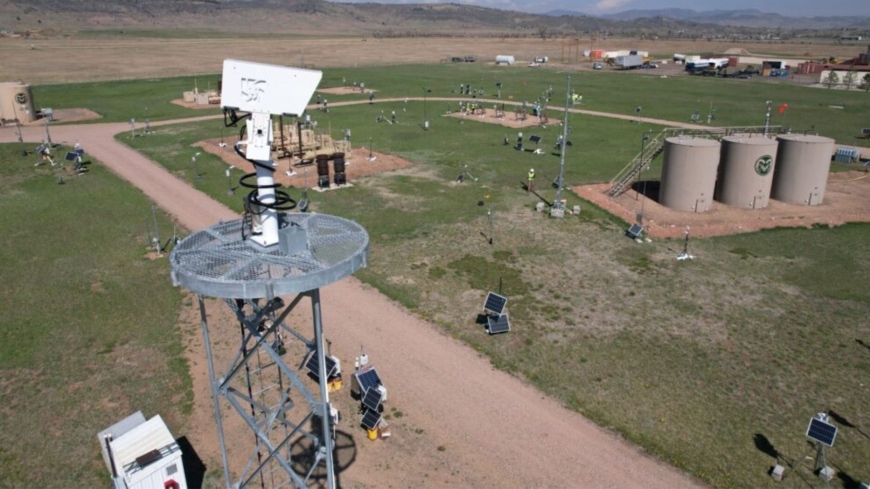
To advance industry confidence in PEM approaches, Arolytics engaged the Methane Emissions Technology Evaluation Center (METEC) as part of the Colorado State University to independently evaluate a core component of AroIQ.
METEC is a globally recognized research organization specializing in objective, third-party evaluation of methane detection and quantification technologies. In this study, METEC assessed AroIQ’s machine-learning clustering model - a foundational element of its parametric emission monitoring methodology.
The goal of the evaluation was to determine whether AroIQ’s clustering approach could reliably identify distinct operating states within a real oil and gas facility using SCADA data alone, and whether those states correlated with independently measured indicators of emissions behavior. Importantly, METEC acted as an independent evaluator, designing a custom analysis framework in the absence of existing standards for PEM software evaluation.
How METEC Reviewed the AroIQ Model
For the study, METEC analyzed a high-resolution SCADA dataset provided by Arolytics, covering nearly ten months of minute-level operational data from an oil and gas facility. The dataset included hundreds of SCADA signals, while measured flare flow rates were intentionally excluded from the final clustering process and used only for validation.
AroIQ’s model clustered the SCADA data into distinct operating states based purely on operational behavior (a previous blog on this approach is here.) METEC then evaluated whether these clusters meaningfully differentiated periods of higher and lower flare flow rates - serving as an external indicator of abnormal or emissions-relevant operating conditions.
METEC applied multiple statistical techniques, including distribution comparisons, distance metrics, and regression analysis, to assess whether the clustering output aligned with known operational indicators of emissions activity. The evaluation explicitly examined both training and test datasets to assess consistency and generalization over time.
Key Conclusions from METEC
METEC’s analysis reached several important conclusions:
- Operational states identified by AroIQ were statistically distinct. Clusters produced by the model showed significantly different flare flow rate distributions, particularly among clusters associated with higher mean flow rates.
- High-emission operating conditions were concentrated in a subset of clusters. A relatively small number of clusters captured a disproportionate share of high flare flow events, indicating that the model successfully isolated abnormal operating behavior.
- Clusters consistently reflected abnormal operations beyond flare data. Independent of flare flow rates, METEC found that the clusters were characterized by abnormal SCADA signal behavior, reinforcing that the model was identifying meaningful operational conditions rather than noise.
- The approach demonstrated robustness across time. While some variation between training and test data was observed - likely due to seasonal and operational changes - the clustering approach remained effective across both datasets.
Overall, METEC concluded that AroIQ’s clustering model demonstrates the technical feasibility and promise of machine-learning-driven parametric emission monitoring using SCADA data. The study characterizes PEM as a credible and valuable direction for future emissions monitoring and mitigation strategies. - Stephan Becker, Chief Product Officer
Why This Matters for the Industry
Independent validation by METEC is a meaningful milestone for PEM as a category. The study demonstrates that emissions-relevant operational behavior can be detected using existing facility data - without requiring continuous deployment of additional measurement hardware.
For operators, this supports a shift toward continuous, software-based emissions intelligence that complements and potentially replaces measurement programs, reduces reliance on manual investigations, and enables faster identification of abnormal operating conditions that drive methane emissions.
For regulators, researchers, and technology developers, the METEC evaluation provides a transparent, third-party assessment of how PEM models can be evaluated in the absence of established protocols - helping move the industry toward greater standardization and confidence in these approaches.
Access the Full METEC Report
The complete independent evaluation, including methodology, statistical analysis, figures, and detailed results, is available directly from METEC.
Download the full METEC Parametric Emission Monitoring Report here